

When Every Gram Matters
Semi-Tubular Rivets -
The Lightweight Solution
For Strong Connections
Semi-tubular rivets enable durable mechanical joints while reducing material usage. Their partially hollow shank significantly reduces the setting force required during riveting compared to solid rivets, allowing components to be joined with less stress on the surrounding material.
They are therefore particularly suitable for thin-walled components, softer materials and lightweight assemblies where controlled forming behaviour is essential.
The lower setting force also supports stable, repeatable joining processes in automated production environments while ensuring reliable load transfer and consistent joint quality.
Typical applications include lightweight structures, precision mechanisms and assemblies where low riveting forces and predictable forming behaviour are critical.
When Less Is More
What Function Do Semi-Tubular Rivets Fulfil?
Semi-tubular rivets create permanent mechanical joints with reduced forming forces. Their partially hollow shank enables controlled plastic deformation during riveting, making them particularly suitable for thin materials and sensitive components.
Design Principle
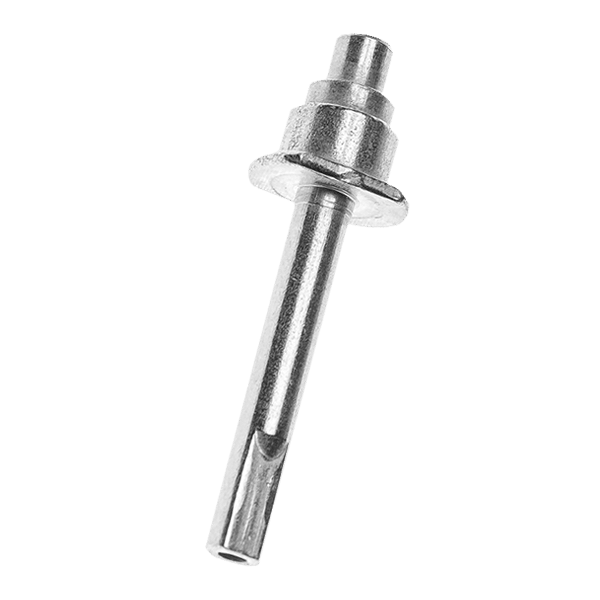
A semi-tubular rivet consists of a pre-formed head and a shank with an axial recess at its end.
This partially hollow geometry reduces the material volume that must be plastically deformed during the joining process.
Riveting Process
During riveting, the rivet is inserted through the prepared holes of the components to be joined.
A setting punch then compresses the shank axially, causing the material to expand radially and form the closing head on the opposite side.
Functional Result
The process creates a force-fit and form-fit connection that permanently secures the components while ensuring reliable load transfer and stable positioning.

If Semi-Tubular Rivets Are Not the Right Solution - We Offer More
Fastening Technology at Its Best!
Not every application requires a lightweight rivet design. Depending on load conditions, material combinations and functional requirements, different fastening concepts may be more suitable.
That is why we offer a broad portfolio of cold-formed fastening elements and precision parts, manufactured using high-performance cold extrusion processes. Our solutions are designed for reliable joining in a wide range of mechanical and industrial applications.
Rivets

Sleeves & Bushings

Bolts
Less Material. Full Performance.
Not Hollow - Our Semi-Hollow Rivets Deliver Full Performance!
Our cold-extruded semi-tubular rivets combine reliable fastening performance with a weight-saving design. They impress through their efficiency and the wide range of materials available. Whether steel, stainless steel, aluminium, brass or copper – we supply the right solution for your application, tailored to load conditions, material combinations and processing requirements.
The reduced setting forces protect both components and processes, making semi-tubular rivets particularly suitable for automated assembly operations and demanding material pairings, such as metal-to-plastic connections.
Material Utilisation
The process utilises almost the entire material volume – no chips, no waste, minimal losses.
This significantly reduces both material consumption and waste, making the process not only efficient but also resource-conserving.
Dimensional Accuracy
Each component is manufactured with consistent precision and repeatability – essential for applications where even the smallest deviation matters.
Work Hardening
This results in work hardening, where the microstructure becomes denser and the mechanical strength increases.
The result: high structural stability and long-term performance, even under demanding operating conditions.
Surface Quality
This reduces friction and enables precise integration into assemblies, even with tight fits and sensitive component surfaces.
for Your Application
This ensures optimal integration into existing systems, both technically and economically.
Even in High Volumes
The result: fewer rejects, efficient assembly and predictable unit costs.
Construction
Like in sport, every gram counts – enabling designs that remain dynamic, efficient and structurally resilient.
Countless Applications
Less Mass, More Class!
Industries We Strengthen with Semi-Tubular Rivets

Lightweight, Reliable, Proven – Semi-Tubular Rivets in Vehicle Construction
Reliable Joining - Even with Sensitive Electronics
Compact in Design – Strong in Function
Function Meets Form – Invisibly Strong Connections
Customers Who Trust Our Solutions


Save Weight. Not on Quality.
Semi-Tubular Rivets Manufactured Exactly to Your Drawings
We manufacture semi-tubular rivets precisely according to your drawings and specifications – with consistent quality and reliable, repeatable processes.
From feasibility assessment to stable series production, our team ensures that your rivet solution is technically robust, economically viable and precisely matched to your application.
- Lennart Sakuth, Technical Sales

Light as a Feather or Engineered for Maximum Strength?
Semi-Tubular Rivet vs. Solid Rivet - The Differences at a Glance
To support your design decision, we have compared the key characteristics of both fastening solutions.
Conclusion:
Semi-tubular rivets are the preferred solution where low weight, efficient material usage and reliable joining of sensitive materials are required – for example in electrical engineering, vehicle construction or plastic assemblies. Solid rivets are the better choice where
maximum strength and fatigue resistance are required – for example in mechanical engineering or in heavily loaded structural connections.


Hollow, But Not Weak
The Right Material - For High-Performance Joining Solutions
Semi-tubular rivets may appear inconspicuous – yet they play a decisive role in many assemblies. Choosing the right material is essential: it influences not only strength, but also weight, corrosion resistance and long-term performance in the respective application.
Whether in the automotive industry, electrical engineering or furniture construction, we manufacture semi-tubular rivets from the material that best meets your requirements.
Technically precise. Functionally reliable. Tailored to your industry.
Would You Like to Learn More About Semi-Tubular Rivets?
Clear Answers – Precise, Practical and Technically Relevant
It helps identify the most suitable rivet solution for your application.
-
What Are Semi-Tubular Rivets and How Do They Differ from Solid Rivets?
-
In Which Industries Are Semi-Tubular Rivets Commonly Used?
-
Which Materials Are Used for Semi-Tubular Rivets?
-
How Do Semi-Tubular Rivets Perform Under High Loads?
-
How Is the Quality of Semi-Tubular Rivets Ensured?
Precisely Formed. Reliably Connected.
Learn More About the Production of Our Semi-Tubular Rivets
If you would like to learn more about our manufacturing processes, explore the following pages:
- Cold Extrusion: How our precision semi-tubular rivets are manufactured
- Cold Forming vs. Machining: The advantages of our forming technology
- Special Parts: Custom production according to your drawings and specifications

We Are Ready to Support Your Project
Let's Talk About your Semi-Hollow Rivet!
We look forward to discussing your requirements and identifying the most suitable solution for your semi-tubular rivet.
Feel free to contact us to discuss your project and technical requirements.
– Lennart Sakuth, Technical Sales
