
Cold Forming vs Turning
The Strategic Choice for High-Performance Series Production.
Many components traditionally produced by turning – such as sleeves, bolts and rivets – can be manufactured more efficiently, more consistently and with significantly lower material usage through cold extrusion.
In many applications, cold extrusion outperforms turning in precision, strength and process stability, especially in high-volume production.
Identify where cold extrusion becomes your competitive edge.
Cold Forming Compared to Turning
Pushing the Boundaries of What’s Possible
When precision, efficiency and scalability matter, cold forming makes the decisive advantage.
This is where its strengths become evident:
Maximum Precision
Production cycles that pack a punch!
Superior Mechanical Strength
Up to 80% Material Savings
Optimised Surface Quality
Fast Return on Investment


Increased Precision
No Tolerance for Inaccuracy
If the precision of critical connecting elements – for example in a car seat – is insufficient, the consequences can range from unwanted noise to serious safety risks.
Cold forming ensures:
-
consistently tight tolerances
-
reduced risk of product failure
-
reliable long-term functionality under load

Faster Production Cycles
Our Presses Set the Pace in Series Production
Modern lathes typically produce up to 50 turned parts per minute, depending on component complexity.
Cold forming significantly increases output. Depending on geometry and press configuration, between 100 and 250 parts per minute can be produced – creating clear advantages in high-volume manufacturing.
Note: The video is a high-speed recording with 5000 frames per second.
Cold Forming vs. Turning – A Direct Comparison
Significantly Higher Output


| Manufacturing Method | Single-Spindle Lateh | Multi-Spindle Lathe | Multi-Stage Cold Forming Machine |
|---|---|---|---|
| Setup Time | 2 h | 6 h | 14 h |
| Cycle Time per Part | 75 s | 12 s | 0.60 s |
| Production Time for 1,000 Parts | 22.83 h | 9.33 h | 14.17 h |
| Production Time for 100,000 Parts | 2,085.33 h | 339.83 h | 31 h |
Blow by blow
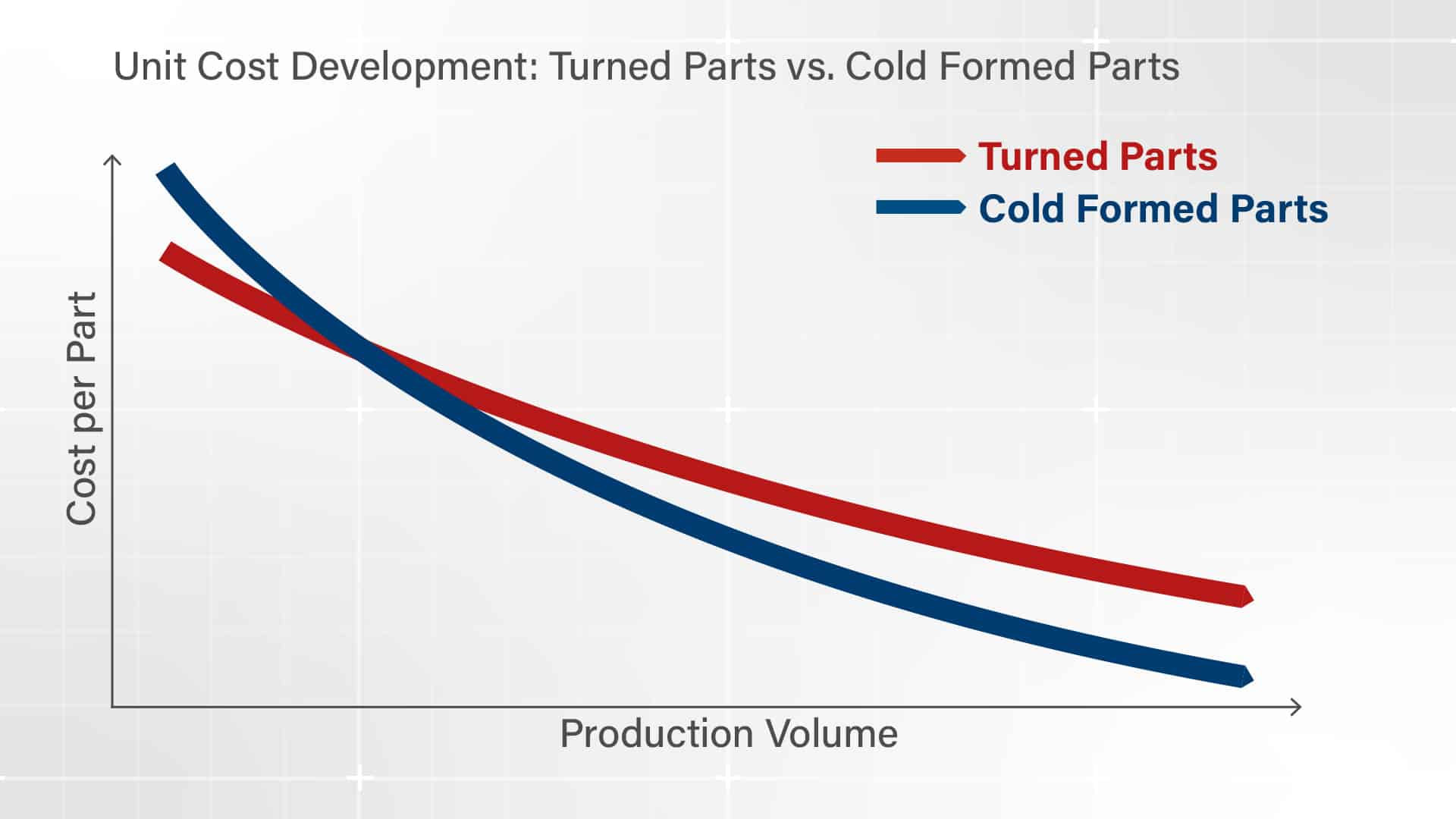
Cold Forming Pays Off at Scale
Find out how much faster your series production could run – or contact us and let’s calculate your advantage together.
Improved Mechanical Properties
Strength Built In - Not Added Later
Many turned parts require additional heat treatment to achieve the desired hardness. Strength is added after machining – through an extra production step.
Cold extrusion works differently.
In cold forming, the material is strengthened during the forming process itself.
Continuous fibre flow and controlled work hardening create superior mechanical properties directly in the component.
Strength is not added.
It is engineered into the part.
- No extra tempering
- No additional production step
- No unnecessary costs
Through smart process engineering and precise tool design, supported by finite element simulation, we define the required mechanical properties during forming – not afterwards.
The result:
- Higher load capacity
- Greater structural integrity
- Shorter production chains
- Lower overall costs

Companies That Trust Our Expertise


Do You Have Any Questions or Specific Requirements?
My Advice Is as Precise as Our Cold-Formed Parts.
Call me or send me an email.
- Thomas Heimlich, Technical Sales / Customer Engineering

Material Savings of up to 80%
Make the Most of Every Gram You Pay For
When turning, components are machined from solid stock.
Material is cut away – creating chips that must be collected, recycled and handled.
Cold forming follows a fundamentally different principle.
The material is pressed into shape under high pressure.
The fibre flow remains intact – and material loss is reduced to a minimum.
The result:
Savings of 60 to 80% in material costs – especially valuable when working with high-grade steels, stainless steel or non-ferrous alloys.
At the same time, you reduce waste, lower energy consumption and improve your sustainability performance.

Smoother Surface Finish
When Precision Must Run Smoothly
Machining removes material.
And every cutting operation leaves its mark.
Tool contact, chip formation and interrupted fibre flow inevitably increase surface roughness.
Cold forming works differently.
The material is shaped under pressure – without cutting, without disrupting the fibre structure.
The result:
• Significantly lower roughness values
• Higher load-bearing capacity
• Reduced friction and wear
In many applications, additional finishing steps become unnecessary.
When performance depends on surface integrity, cold forming sets the standard.


Short Amortisation Period
Faster ROI. Earlier Break-Even.
At first glance, tooling and machine set-up costs may appear higher than for turning.
The decisive factor is volume.
Cold extrusion typically achieves a significantly faster return on investment — particularly for production volumes of 250,000 units or more.
This is driven by:
• High output and economies of scale
• Low tool wear
• Short cycle times
The result: lower unit costs and rapid amortisation.
Cold Forming – Extended by Precision Machining
Integrated Solutions Without Compromise
Cold forming is our core technology.
In many applications, it delivers the most efficient and technically superior manufacturing solution. The structural advantages, continuous fibre flow and outstanding material efficiency make it the preferred choice for high-performance series components.
Where specific design features – such as grooves, threads or transverse bores – cannot be fully realised through forming alone, we integrate precision machining directly into the process chain.
Turning is used only where it is technically necessary – not as the primary manufacturing strategy.
No external suppliers.
No interface losses.
No unnecessary process steps.
This approach allows you to retain all the structural and material advantages of cold forming while achieving the exact functional detail your component requires.

The Challenge:
The head geometry required tight tolerances combined with cost-efficient series production. In addition, an annular groove in the rear section had to meet strict functional requirements.
Solution:
By combining cold forming with precisely integrated machining of the ring groove, we achieved an optimal balance between efficiency and accuracy.
The forming process ensures material efficiency, structural strength and dimensional stability. The additional machining step is limited strictly to the necessary functional element.
Result:
• Maximum material efficiency
• Exact functional geometry
• Cost-effective series production
• Preservation of the structural advantages of cold forming
The customer continues to benefit from the material savings and mechanical performance of cold extrusion - without compromising on precision or functionality.

Challenge: The gear wheel axle is used to release the brake pads on heavy-duty vehicles.
Its internal Torx geometry ensures fast and reliable torque transmission.
Producing this complex geometry entirely by machining would require extensive material removal and long processing times – resulting in significantly higher costs.
At the same time, a functional groove at the end of the component is required for a safety clip.
The component combines:
⚙️an angled gear rim
🪛with internal Torx
- a demanding combination that is inefficient to produce prurely by machining.
Solution:
We chose the most efficient path from the start.
The complex geometry – including the internal Torx and angled gear rim – is created through cold extrusion, preserving continuous fibre flow and material strength.
Only the functional groove is machined afterwards.
Instead of machining the entire component, we rely on cold forming to create the primary geometry with maximum efficiency and precision.
We machine only the features that cannot be formed.
Result:
• Maximum material efficiency
• Superior mechanical properties through cold forming.
• Minimal machining effort
• Cost-optimised production, even for demanding geometries.
Cold forming delivers the performance.
Machining refines it where necessary.

Challenge: The requirements for this component are exceptionally high. In the premium segment, there is no room for compromise – every detail must perform flawlessly.
✓ The cold extruded blank already features a friction-locked knurl for secure anchoring.
✓ The bore is pre-stamped with an internal step to minimise subsequent internal machining.
✓ A groove with an external chamfer must be precisely introduced.
✓ The internal thread requires maximum dimensional accuracy and quality to avoid unwanted play and noise.
Producing all these features purely by machining would increase material consumption and extend processing times significantly. At the same time, the component must maintain superior mechanical properties and long-term durability.
Solution:
We rely on cold extrusion to form the essential contours directly within the process. This reduces material consumption and shortens subsequent machining time from the outset.
Where necessary, machining is applied selectively and precisely – only for features that cannot be formed. In this case, the groove and internal thread are machined after forming.
Despite the necessary machining steps, the component retains the full mechanical strength of a cold-formed part – including continuous fibre flow and enhanced structural integrity.
By smartly combining cold forming and machining, we achieve maximum efficiency without compromising technical performance.
Result:
• Maximum material efficiency
• Significantly reduced machining time
• Superior mechanical properties through cold forming
• Premium-level dimensional accuracy
• Cost-optimised production for demanding automotive applications
The most efficient process is not the one that removes the most material.
It is the one that shapes performance from the start.


Your Advantages with MN
You Deserve a Partner Who Thinks for You.

Experienced Employees
Quality Assurance
Environmental Responsibility
Ready to Unlock the Full Potential of Cold Forming?
Let’s Explore What’s Possible – Together

The Future Is Not a Vision - It´s a Responsibility
We Are Already Engineering What Comes Next
Green Steel
Weight Reduction
Multifunctionality
Ready to Unlock Your Competitive Advantage?
Let’s Turn Engineering Potential Into Measurable Results
- Hardy Gundermann, Technical Managing Director
